Mitchell Starc Becomes First Left-Armer to 450 Test Wickets
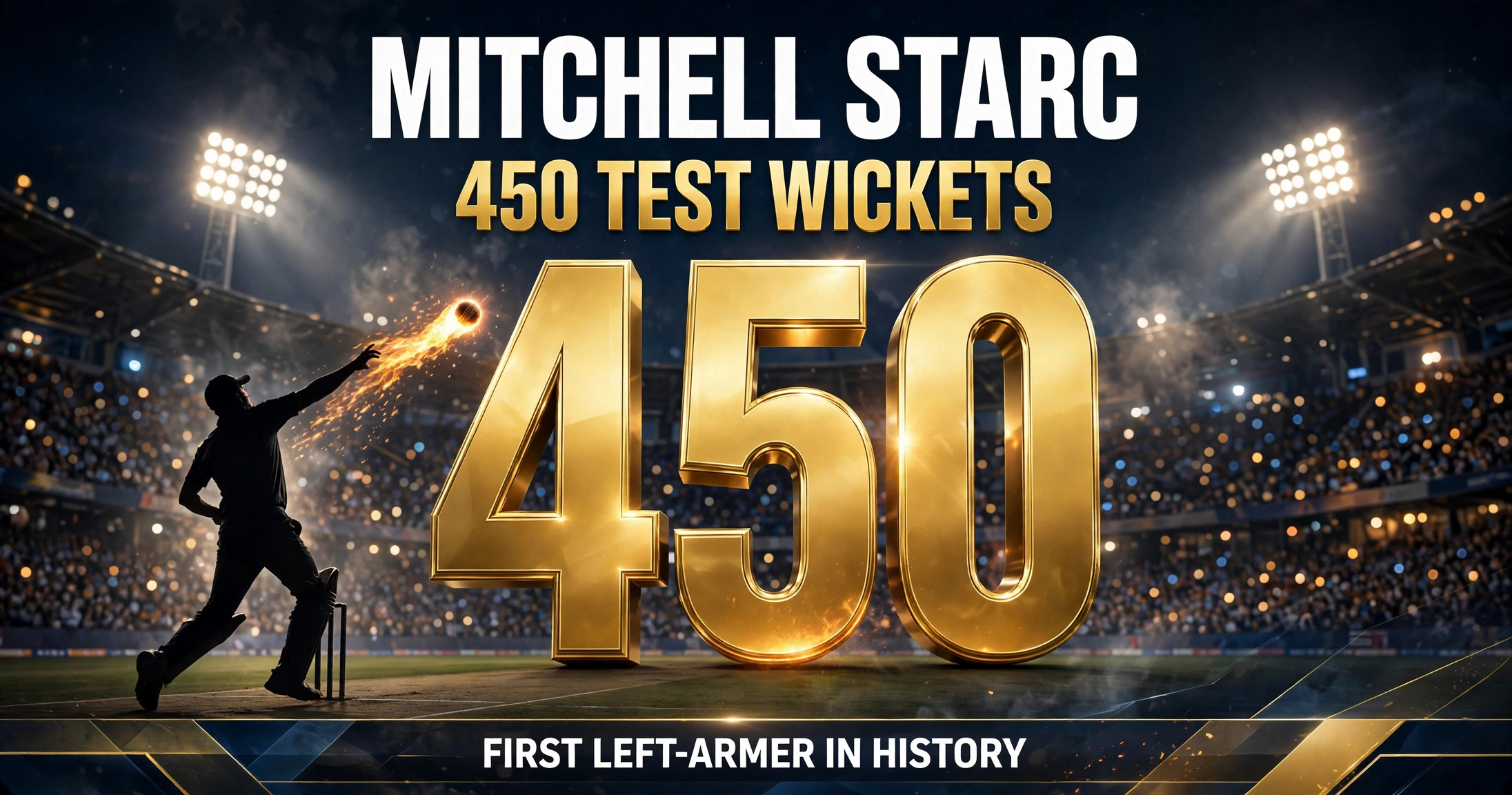
It arrived the way all the best Mitchell Starc wickets arrive — with menace. A short ball at 144kph, climbing steeply at South Africa all-rounder Wiaan Mulder early on day three of the second Test at St George's Park in Gqeberha. Mulder, caught by the bounce, could only raise his hands in front of his face. The ball brushed his top hand, cannoned off his helmet, and ballooned to Matthew Renshaw at second slip. The on-field umpire stayed unmoved; Pat Cummins sent it upstairs without hesitation; UltraEdge confirmed the glove. Mulder walked for 13 off 38 balls, and Starc had done what no left-arm bowler in 149 years of Test cricket had ever done: 450 Test wickets.
He had started this three-match series on 448. Rain washed out huge chunks of the first two days, but when play finally flowed on Tuesday, Starc needed just two scalps — Matthew Breetzke, caught behind for 4 on day two, took him to 449, and Mulder's glove-and-helmet dismissal in the first session on day three sealed the milestone in his 109th Test.
The raw numbers barely do it justice, but they deserve to be stated plainly. Starc is the first left-arm bowler — quick or spinner — to 450 Test wickets. He is only the tenth bowler of any kind to reach the mark, the fourth Australian after Shane Warne (708), Nathan Lyon (573) and Glenn McGrath (563), and just the fifth fast bowler in history to get there. He also smashed McGrath's record for the fastest to 450 in terms of balls bowled, needing 20,577 deliveries against McGrath's 23,474 — a gap of nearly 3,000 balls that speaks to Starc's career-long strike rate of under 46 balls per wicket.
⭐ THE 450 CLUB — every bowler to reach 450 Test wickets
Starc is member No. 10. Note the strike bowlers at the top of the pace list — and that he is the only left-armer among them.
| # | Bowler | Team | Wickets | Arm |
|---|---|---|---|---|
| 1 | Muttiah Muralitharan | Sri Lanka | 800 | Right |
| 2 | Shane Warne | Australia | 708 | Right |
| 3 | James Anderson | England | 704 | Right |
| 4 | Anil Kumble | India | 619 | Right |
| 5 | Stuart Broad | England | 604 | Right |
| 6 | Nathan Lyon | Australia | 573 | Right |
| 7 | Glenn McGrath | Australia | 563 | Right |
| 8 | Ravichandran Ashwin | India | 537 | Right |
| 9 | Courtney Walsh | West Indies | 519 | Right |
| 10 | Mitchell Starc | Australia | 450* | Left ✅ |
Faster Than McGrath — By Nearly 3,000 Balls
The balls-bowled record is the more telling statistic. McGrath reached 450 in his 100th Test; Starc needed 109 matches. But because Starc bowls to take wickets rather than to contain — attacking the stumps, reversing the old ball, hunting the tail — he got there in 20,577 deliveries, almost 500 overs fewer than McGrath's 23,474. Nobody in 149 years of Test cricket has reached 450 wickets as quickly by the ball. It is the purest measure of his method: Starc has never been interested in dot balls for their own sake.
By matches, his 109 Tests make him the sixth-fastest to the mark overall (Muralitharan did it in 80, Ashwin in 89, Kumble in 93) and the third-fastest Australian behind McGrath and Warne. Dennis Lillee, the next name on Australia's list, sits well back on 355 — a measure of the gap Starc has opened over every Australian quick not named McGrath.
Fifteen Years of the Left-Arm Thunderbolt
Starc made his Test debut against New Zealand in December 2011, a gangly 21-year-old with a slingy action and raw pace. Fifteen years on, at 36, he is the spearhead Australia turn to when a series needs winning. He brought up 400 in his 100th Test against the West Indies in July 2025 and has needed just nine more appearances for the next 50 — form that followed a home Ashes summer in which he was named Compton–Miller Medallist as player of the series for 31 wickets at 19.93 across all five Tests.
Along the way he has passed every great left-armer the game has produced: Pakistan's Wasim Akram (414), Sri Lanka's Rangana Herath (433), New Zealand's Daniel Vettori, India's Ravindra Jadeja. Left-arm pace at express speed is one of cricket's rarest commodities — the angles are awkward, the swing is late, and very few bodies survive the workload for a decade and a half. That is why this record stood untouched for so long, and why it may stand for a very long time yet.
"But I'm most fond of being part of attacks that can go out there and win games … win series, they're the things I enjoy the most reflecting on." — Mitchell Starc
The Match Around the Milestone: Bavuma's 179 Steals the Day
For all the Australian celebration, day three belonged to South Africa's captain. Temba Bavuma walked in with his side 110 for 6 and produced a career-best 179 off 334 balls with 18 fours, dragging South Africa to 425 for 9 declared — the longest innings by a South African against Australia since readmission. Marco Jansen smashed 85 off 100 in a 132-run stand, and Simon Harmer's 82 off 157 completed a South African record 183-run eighth-wicket partnership.
Scott Boland, the man who justified Nathan Lyon's omission with a double strike on day one, finished with 5 for 81 — his third Test five-wicket haul — while Starc ended with 3 for 89. By stumps, with bad light ending play, Australia were 1 for 3 in reply: Nic Maddinson gone for a duck to Kagiso Rabada, Travis Head 1 not out and nightwatchman Boland 2 not out, still 422 behind. Australia lead the series 1-0 after the 214-run win in Durban, but they have not won a Test in Gqeberha since 1997 — and after Bavuma's marathon, this one is going nowhere fast.
Day 3 stumps, 2nd Test, St George's Park, Gqeberha — bad light ended play; Australia lead the three-match series 1-0
🗳️ Fan question: can Starc reach 500?
Fifty more wickets stand between Starc and the 500 club — a group of nine bowlers in history. The maths: Starc takes about 4.1 wickets per Test (450 in 109), so roughly 12 more Tests would do it. At 36, that means staying fit and firing into 2028. His form says yes (50 wickets in his last 9 Tests); his age says it will be close. What do you think — does he get there? Tell us in the comments on our socials.
Fifteen years, 109 Tests, and now a record no left-armer has ever touched. Whatever the rest of this Gqeberha Test brings, October 20, 2026 is the day Mitchell Starc put left-arm bowling where it had never been — at the very top of the mountain.